Koreksi Pasal 2
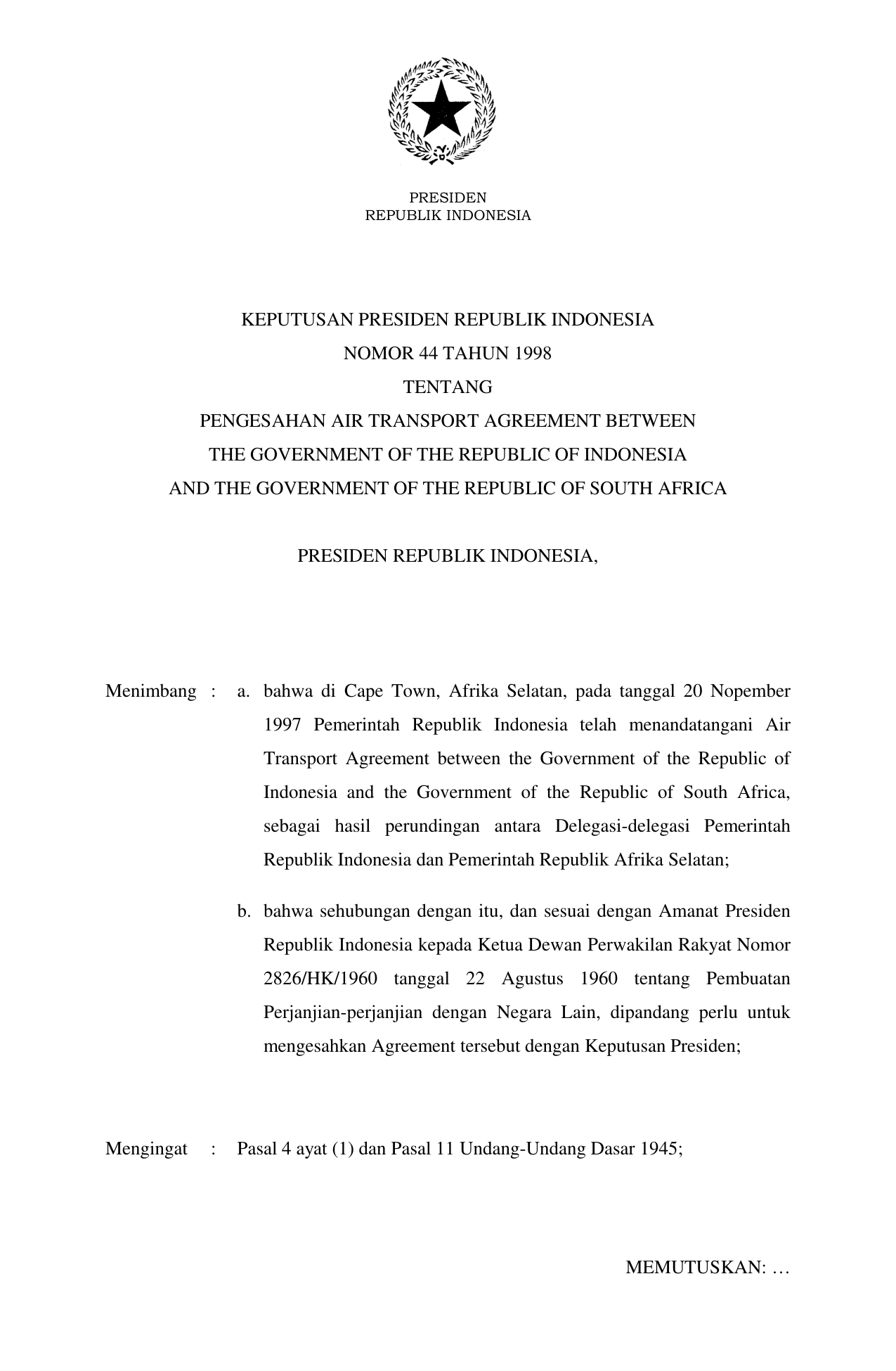
KEPPRES Nomor 44 Tahun 1998 | Keputusan Presiden Nomor 44 Tahun 1998 tentang PENGESAHAN AIR TRANSPORT AGREEMENT BETWEEN THE GOVERNMENT OF THE REPUBLIC OF INDONESIA AND THE GOVERNMENT OF THE REPUBLIC OF SOUTH AFRICA
Teks Saat Ini
Keputusan PRESIDEN ini mulai berlaku pada tanggal ditetapkan.
Agar …
Agar setiap orang mengetahuinya, memerintahkan pengundangan Keputusan PRESIDEN ini dengan penempatannya dalam Lembaran Negara Republik INDONESIA.
Ditetapkan di Jakarta pada tanggal 10 Maret 1998 PRESIDEN REPUBLIK INDONESIA ttd.
SOEHARTO Diundangkan di Jakarta pada tanggal 10 Maret 1998 MENTERI NEGARA SEKRETARIS NEGARA
ttd.
MOERDIONO LEMBARAN NEGARA REPUBLIK INDONESIA TAHUN 1998 NOMOR 62
AIR TRANSPORT AGREEMENT BETWEEN THE GOVERNMENT OF THE REPUBLIC OF INDONESIA AND THE GOVERNMENT OF THE REPUBLIC OF SOUTH AFRICA The Government of the Republic of INDONESIA and the Government of the Republic of South Africa, hereinafter referred to in this Agreement as the "Contracting Parties";
BEING Parties to the Convention on International Civil Aviation opened for signatur at Chicago on the seventh day of December, 1944; and DESIRING to conclude an Agreement, supplementary to the said Convention, for the purpose of establishing scheduled air services between and beyond their respective territories;
HAVE AGREED AS FOLLOWS :
ARTICLE 1 DEFINITIONS For the purpose of this Agreement, unless the context otherwise indicates::
a) the term aeronautical authorities means, in the case of the Republic of INDONESIA, the Minister of Communications and, in the case of the Republic of South Africa, the Minister responsible for civil aviation, or in either case any person or body authorized to perform any particular function provided for in this Agreement.
b) the term Agreement means this Agreement, its Annex and any amendments thereto;
c) the term air service, international air service, airline and stop for non-traffic purposes have the meaning respectively assigned to them in Article 96 of the Convention;
d) the term agreed services means the international air services which can be operated, according to provisions of this Agreement, on the specified routes;
e) The term the Convention means the Convention on International Civil Aviation, opened for signature at Chicago, on 7 December, 1944, and include any Annex adopted under Articles 90 of that Convention and any amendment of the Annexes
and Convention adopted under Article 90 and 94 thereof so far as those Annexes
and ammendments have become effective for or ratified by both Contracting Parties;
f) the term designated airline means, one of more airline(s) designated and authorized in accordance with Article 3 of the Agreement;
g) the term regular equipment means, articles other than stores and parts of a removable nature, for use on board an aircraft during flight, including first aid and survival equipment;
h) the term spare parts means, articles of a repair or replacement nature for incorporation in an aircraft, including engines;
i) the term specified routes means the routes established or to be established in the Annex to this Agreement;
j) the term tariff means the prices to be paid for the carriage of passengers, baggage and cargo and the conditions under which those prices apply, including prices and conditions for agency and other auxiliary services, but excluding remuneration or conditions for the carriage of mail;
k).
the term territory means, in the case of the Republic of INDONESIA, the territory of the Republic of INDONESIA as defined in its laws and in the case of the Republic of South Africa the meaning assigned to it in Article 2 of the Convention.
ARTICLE 2 TRAFFIC RIGHTS
1. ach Contracting Party grants to the other Contracting Party the rights specified in the Agreement for the purpose of establishing international schedule air services on the routes specified in the appropriate Section of the Annex thereto.
2. The airline(s) of each Contracting Party shall enjoy the following rights:
a) to fly without landing across the territory of the other Contracting Party;
b) to make stops in the said territory for non-traffic purposes; and c) to make stops in the said territory at points specified in the Route Schedule of the Annex to this Agreement for the purpose of taking on or putting down, on international traffic, passengers, cargo and mail in accordance with the provisions
of the Annex to this Agreement, to or from the territory of the other Contracting Party or to or from the territory of another state.
3. Nothing in sub-article 2 of this Article shall be deemed to confer on the designated airline(s) of one Contracting Party the right of taking on in the territory of the other Contracting Party, passengers, cargo or mail carried for remuneration or hire and destined for another point in the territory of that Contracting Party.
4. Notwithstanding the provisions of sub-articles (1) and (2) of this Article, the operation of the agreed services in areas of hostilities or military occupation, or in areas affected thereby, shall, in accordance with Article 9 of the Convention, be subject to the approval of the competent military authorities.
ARTICLE 3 OPERATING AUTHORIZATION
1. Each Contracting Party shall have the right to designate in writing, through the diplomatic channel, to the other Contracting Party one or more airline(s) for the purpose of operating the agreed service on the specified routes.
2. On receipt of such designation, the other Contracting Party shall, subject to the provision of paragraph (4) and (5) of this Article, without delay grant to the designated airline(s) the appropriate operating authorizations.
3. Each Contracting Party shall have the right, by written notification to the other Contracting Party, to withdraw the designation of any such airline(s) and to designate another one.
4. The airline(s) designated by either Contracting Party may be required to satisfy the other Contracting Party that it is qualified to fulfil the conditions prescribed by the laws and regulations normally applied by this Contracting Party to the operation of international air services in conformity with the provisions of the Convention.
5. Each Contracting Party shall have the right to refuse to grant the operating authorization referred to in sub-article (2) of this Article, or to impose such conditions as it may deem necessary on the exercise by a designated airline of the rights specified in Article 2 (traffic Rights) of the Agreement, in any case were the said Contracting Party is not satisfied that substantial ownership and effective
control of that airlines are vested in the Contracting Party designating the airline or in its nationals.
6. When an airline(s) has been so designated and authorized, it may at any time begin to operate the agreed services, provided that a tariff established in accordance with the provisions of Article 11 (Tariffs) of the Agreement is in force and an agreement in accordance with the provisions of Article 9 (Capacity) of the Agreement has been reached in respect of that service.
ARTICLE 4 SUSPENSION AND REVOCATION
1. The aeronautical authorities of each Contracting Party shall have the right to revoke an operating authorization or suspend the exercise of the rights specified in sub-article (2) of Article 2 (Traffic Rights) of the Agreement by the airline (s) designated by the other Contracting Party, or to impose such conditions as it may deem necessary on the exercise of those rights :
a. in any case where it is not satisfied that substantial ownership and effective control of that airline(s) are vested in the Contracting Party designating the airline(s) or in nationals of such Contracting Party, or
b. in case of failure by that airline(s) to comply with the laws or regulations of the Contracting Party granting these rights, or
c. in case the airline(s) otherwise fails to operate the agreed services in accordance with the conditions prescribed under the Agreement.
2. Unless immediate revocation, suspension or imposition of the conditions mentioned in sub-article (1) of this Article is essential to prevent further infringements of laws or regulations, such right shall be exercised only after consultations with the other Contracting Party. In such a case consultations shall begin within a period of thirty (30) days from the date of such request made by either Contracting Party.
ARTICLE 5
LAWS AND REGULATIONS
1. The laws and regulations of each Contrcating Party controlling the admission to, sojourn in, or departure from its own territory of aircraft engaged in international
air services or related to the operation of aircraft while within its territory, shall be applied to the aircraft of the designated airline(s) of the other Contracting Party.
2. The laws, regulations and procedures of one Contracting Party relating to the admission to, sojourn in and departure from its territory of passengers, crew, baggage, cargo or mail of aircraft (including laws and regulations relating to entry, clearance, aviation security, immigration, passports, customs, quarantine and sanitary measures, or in the case of mail, postal laws and regulations) shall be complied with by or on behalf of such passengers, baggage, crew, cargo or mail of the designated airline(s) of the other Contracting Party upon entrance into or departure from and while within the territory of the first Contracting party.
3. Passengers, baggage, cargo and mail in direct transit across the territory of either Contracting Party and not leaving the area of the airport reserved for such purposes shall, except in respect of security measures, narcotics control or in special circumstances, be subject to no more than a simplified control.
4. Neither Contracting Party may grant any preference to its own or any other airline over the designated airline(s) of the other Contracting Party in the application of the laws and regulations referred to in this Article.
ARTICLE 6 CERTIFICATES AND LICNSS
1. Certificates of airworthiness, certificates of competency and licenses issued or rendered valid by one Contracting Party and still in force shall be recognized aas valid by the other Contracting Party for the purpose of operating the agreed services on the specified routes in the Annex to this Agreement, provided that the requirements under which such certificates and licenses were issued or rendered valid are equal to or above the minimum standards which may be established pursuant to the International Civil Aviation Organization.
2. Each Contracting Party reserves the right, however, or refusing to recognize the validity of the certificates of competency and the licenses granted to its own nationals by another State, for the purpose of overflying its own territory.
3. If the privileges or conditions of the licenses or certificates issued or rendered valid by one Contracting Party permit differences from the standards established in terms of the Convention, whether or not that differences have been filed with the International Civil Aviation Organization, the other Contracting Party may, without prejudice to the rights of the first Contracting Party, request consultations in accordance with Article 14 (Consultations) with the first Contracting Party with a view to satisfying itself that the practice in question is acceptable to it.
ARTICLE 7 AVIATION SECURITY
1. Consistent with their rights and obligations under international law, the Contracting Parties reaffirm that their obligation to each other to protect the security of civil aviation against acts of unlawful interference forms an integral part of this Agreement.
2. Subject to applicable laws and regulations and without limiting the generality of their rights and obligations under international law, the Contracting Parties shall in particular act in conformity with the provisions of the Convention on Offenses and Certain Other Acts Committed on Board Aircraft, signed at Tokyo on 14 September 1963, the Convention for the Suppression of Unlawful Seizure of Aircraft, signed at the Hague on 16 December 1970 and the Conventions for the Suppression of Unlawful Acts against the Safety of Civil Aviation, signed at Montreal on 23 September 1971, and any multilateral convention on aviation security which may become binding on both Contracting Parties.
3. The Contracting Parties shall provide upon request all necessary assistance to each other to prevent acts of unlawful seizure of civil aircraft and other unlawful acts against the safety of such aircraft, their passengers and crew, airports and air
navigation facilities, and any other threat to the security of civil aviation.
4. The Contracting Parties shall, act in conformity with the Aviation Organization and designated as Annexes to the Chicago Convention to the extent that such security provisions and requirements are applicable to the Contracting Parties; they shall require that operators of aircraft of their registry or operators of aircraft who have their principal place of business or permanent residence in their territory and
the operators of airports in their territory act in conformity with such aviation security provisions.
5. Each Contracting Party agreed that such operators of aircraft may be required to observe the aviation security provisions and requirements referred to in sub-article
(3) above required by the other Contracting Party for entry into, departure from, or while within, the territory of the other Contracting Party.
6. Each Contracting Party shall ensure that adequate measures are effectively applied within its territory to protect the aircraft and to inspect passengers, crew, carry-on items, baggage, cargo and aircraft stores prior to and during boarding or loading.
Each Contracting Party shall also give sympathetic consideration to any request from the other Contracting Party for reasonable special security measures to meet a particular threat.
7. When an incident or threat of an incident of unlawful seizure of civil aircraft or other unlawful acts against the safety of such aircraft, their passengers and crew, airports and air navigation facilities accurs, the Contracting Parties shall assist each other by facilitating communications and other appropriate measures intended to terminate rapidly and safely such incident or threat thereof.
8. If a Contracting Party has reasonable grounds to believe that the other Contrcating Party has departed from the provisions of this Article, the aeronautical authorities of the first Contracting Party may request immediate consultations with the aeronautical authorities of the other Contracting Party. Failure to reach a satisfactory agreement within fifteen (15) days from the date of such request shall constitute grounds for the application of sub-article (1) of Article 4 (Suspension and Revocation). If required by an emergency, a Contracting Party may take action in terms of that sub-article prior to the expiry of fifteen (15) days.
Any action taken in accordance with this sub-article shall be discontinued upon
compliance by the other Contracting Party with the security provisions of this Article.
ARTICLE 8 EXEMPTION FROM CUSTOMS AND OTHER DUTIES
1. Aircraft opereted on agreed services by a designated airline of one Contrcating Party, as well as their regular equipment, supplies of fuel and lubricants (including hydraulic fluids), consumable technical supplies, spare parts (including engines), aircraft stores (including food, beverages liquor, tobacco and other products for sale to or use by passangers, in limited quantities, during the flight) and other items intended for or used solely in connection with the aviation operation or servicing, which are on board such aircraft, shall, on entering into the territory of the Contracting Party, be exempt from customs duties, excise duties and charges, provided such equipment, supplies and stores remain on board the aircraft until they are re-exported or are used or consumed during flight over that territory on the agreed service.
2. There shall also be exempt from the same national or local duties, fees and charges, with the exception of charges based on the cost of the service provided- a) aircraft stores taken on board in the territory of one Contracting Party, within limits as may be fixes by the appropriate authorities of the said Contracting Party, and intended for use on board the aircraft opereted on an international air service by the designated airline(s) of the other Contracting Party;
b) spare parts (including engines) and regular equiptment imported into the territory of one Contracting Party for the maintenance or repair of aircraft operating agreed services by the designated airline(s) of the other Contracting Party;
c) fuel and lubricants (including hydraulic fluids) destined for the designated airline(s) of one Contracting Party to supply aircraft operating agreed services, even when these supplies are to be used on the part of the journey performed over the territory of the other Contracting Party in which they have been taken on board; and d) baggage and cargo in direct transit.
3. The items referred to in paragraphs (a), (b), (c) and (d) of sub-article (2), may be required to be kept under customs supervision or control.
4. The regular equiptment, as well as spare parts (including hydraulic fluids), aircraft stores, supplies of fuel, lubricants (including hydraulic fluids), and other items referred to in sub-article (1) normally retained on board an aircraft operated by the designated airline(s) of one Contracting Party may be unloaded in the territory of the other Contracting Party only with the approval of the customs authorities of that territory. In such case, the may be placed under supervision of those customs authorities until they are re-exported or otherwise disposed of in accordance with the customs laws and procedures of that Contracting Party.
5. The exemptions provided for in this Article shall be available in situations where a designated airline of either Contracting Party has entered into arrangements with another airline or airline or airlines for the loan or transfer in the territory of the other Contracting Party of the items referred to in sub-articles (1) and (2):
Provided such other airlines similarly enjoy such exemptions from the other Contracting Party.
ARTICLE 9 CAPACITY
1. The designated airline(s) of the Contracting Party shall, in all respect, enjoy fair and equal opportunity for the carriage of international traffic between and beyond the territories of the two Parties.
2. In operating the agreed services, the airline(s) of each Contracting Party shall take into account the interest of the airline(s) of the other Contracting Party so as not to affect unduly the services which the letter provides on the whole or part of the
same routes.
3. The agreed services provided by the designated airline(s) of the Contracting Parties shall retain as their primary objective the provision, at a reasonable load factor, of capacity adequate to the current and reasonably anticipated requirements for the carriage of passengers and cargo, including mail, coming from or destined for the territory of the Contracting Party which has designated the airline.
4. The right to take up or discharge on the agreed services international traffic destined for and coming from third countries at a point or points on the routes specified in the Annex to this Agreement shall be exercised in accordance with the
general principles of orderly development of international air transport and shall be subject to the general principle that capacity should be related to :
a) the traffic requirements between the country of origin and the countries of ultimate destination of the traffic;
b) the requirement of through airline operations; and c) the traffic requirements of the area through which the airline passes, taking into account local and regional services.
5. The initial capacity to be provided, the frequency of services to be operated and the nature of air service that is transiting through or terminating in the territory of a Contrcating Party as well as any increases in the capacity to be provided or frequencies of services to be operated by the designated airline(s), shall be agreed between the aeronautical authorities in accordance with the principles laid doqn in this Article.
ARTICLE 10 TECHNICAL AND COMMERCIAL ACTIVITIES Subject to the laws and regulations of the other Contracting Party, the designated airline(s) of each Contracting Party shall have equal opportunities:
(a) to open its own representation in the territory of the other Contracting Party and for this purpose to enter, reside and employ in the other Contracting Party, or to bring in and maintain in the territory of the other Contracting Party those of their own managerial and other specialist staff who are required for the provision of air
services. These staff requirements may, at the option of a designated airline, be staisfied by its own personnel or by using the services of any other organization, company or airline operating in the territory of the other Contracting Party, and authorized to perform such services in the territory of that Contracting Party; and (b) to issue all kinds of documents of carriage, and to advertise and to promote sales in the territory of the other Contracting Party, to engage in the sale of air transportation in that territory directly or at the airline's discretion, through its agents. Each airline shall have the right to sell such transportation in the currency of that territory or in freely convertible currencies of the other countries, in accordance with the monetary regulations of each Contracting Party.
ARTICLE 11 TARIFFS
1. The tariffs to be charges by any designated airline of one Contracting Party for carriage to or from the territory of the other Contracting Party shall be established at reasonable levels, due regard being paid to all relevant factors, including cost of operation, reasonable profit and the tariffs of other airlines.
2. The tariffs referred to in sub-article (1) shall, if posisible, be agreed to by the relevant designated airline(s) of the Contracting Parties and such agreement shall, whenever possible, be reached by the use of the procedures of the International Air Transport Association for the determination of tariffs, or by the use of such other procedures for the establishment of such tariffs as may be agreed by both Contracting Parties.
3. The aeronautical authorities of the Contracting Parties shall, with a view to preserving and enhancing competition, apply the following provisions for the approval of tariffs to be charges by the designated airline(s) of either Contracting Party for carriage between a point in the territory of the one Contracting Party and a point in the territory of the other Contracting Party:
a) A proposed tariff to be charges for carriage between the two countries shall be filed by or on behalf of the designated airline(s) concerned with both aeronautical authorities at least thirty (30) days, or such shorter period as the aeronautical authorities may mutually decide, before the
proposed date of its introduction.
b) Subject to paragraph (c) and (d), any tariffs be treated as having been approved unless within fifteen (15) days of the tariffs being filed, or such shorter period as the aeronautical authorities of both Contracting Parties may mutually decide, the aeronautical authorities of both Contracting Parties have informed each other in writing that they do not approve the proposed tariff or consultations have been requested pursuant to paragraph (c) below.
c) If the aeronautical authorities of either Contracting Party consider that a proposed tariff files with them by a designated airline of the other Contracting Party is or may be excessive, or charging of the proposed tariff might be anti-competitive and cause substantial damage to another designated airline(s) they may, within fifteen (15) days of the proposed tariff being filed, request consultations with the aeronautical authorities of the other Contracting Party. Such consultations, which may be through correspondence, shall be completed within fifteen (15) days of being requested and the tariff shall take effect at the end of that period unless the aeronautical authorities of both Contracting Parties decide otherwise.
d) A tariff established in accordance with the provisions of this Article shall remain in force until a new tariff has been established. Nevertheless, the use of an existing tariff shall not be prolonged by virtue of this paragraph for more than twelve (12) months after the date on which otherwise would have expired.
e) The designated airline(s) of both Contracting Parties may not offer or advertise tariffs different from from those which have been established in accordance with the provisions of this Article.
ARTICLE 12 EXCHANGE OF STATISTICAL DATA
The aeronautical authorities of each Contracting Party shall provide or shall cause its designated airline(s) to provide the aeronautical authorities of the other Contracting Party, upon their request, such periodic or other statements of statistics as may be reasonably required for the purpose of reviewing the operation of the agreed services, including, but not limited to, statements of statistics related to the traffic carried by its designated airline(s) between points in the territory of the other Contracting Party and other points on the specified routes.
ARTICLE 13 FINANCIAL PROVISIONS
1. Subject to applicable national laws and regulations, each Contracting Party shall grants to the designated airline(s) of the other Contracting Party the right of free transfer of the excess of receipts over expenditure earned by such designated airline(s) in the territory of such Contracting Party in connection with the carriage of passengers, baggage,cargo and mail, as well as from any other activities related to air transport which may be permitted under national regulations. Such transfers shall be effected at the rate of exchange in accordance with the respective applicable national laws and regulations governing current payments, but where there is no official exchange rate such transfers shall be effected at the prevailing foreign exchange market rate for current payments.
2. If the form of payment between the Contracting Parties is governed by a special agreement, such an agreement shall apply.
ARTICLE 14 CONSULTATIONS
1. In a spirit of close cooperation, the aeronautical authorities of the Contracting
Parties shall consult each other from time to time with a view to ensuring the implementation or amendment of and satisfactory compliance with, the provisions of the Agreement and the Annex thereto.
2. Subject to Article 4 (Suspension and Revocation) and 7 (Aviation Security) of this Agreement, such consultations shall begin within a period of sixty (60) days from the date of receipt of the request, unless otherwise agreed by the Contracting Parties.
ARTICLE 15 SETTLEMENT OF DISPUTES
1. If any disputes arises between the Contracting Parties relating to the interpretation or application of this Agreement. Contracting Parties shall, in the first place, endeavor to settle it by negotiation.
2. If the Contracting Parties fail to reach a settlement by negotiations, they may agree to refer the dispute to some competent and independent person or body for mediation.
3. (a) If settlement is not reached in accordance with sub-articles (1) or (2) the dispute shall, at the request of either Contracting Party, be submitted for decision to a tribunal of three arbitrators.
(b) Each Contracting Party shall nominate one arbitrator and the third arbitrator, to be jointly appointed by the two arbitrators so nominated, shall act as President of the tribunal.
(c) Each Contracting Party shall nominate its arbitrator within a period of sixty
(60) days from the date of receipt of a notice by either Contracting Party from the other, through the diplomatic channel, requesting arbitration of the dispute by such a tribunal and the third arbitrator who shall be a national of
a third State, shall be appointed within a further period of sixty (60) days.
(d) If either Contracting Party fails to nominate an arbitrator within the period specified, or if the third arbitrator is not appointed within the period specified, the President of the Council of the International Civil Aviation Organization may be requested by either Contracting Party to appoint an arbitrator or arbitrators, as the case may be, provided that the President is not a national of eiher Contracting Party, in which case the Vice President of that Council may be so requested. In such case, the arbitrator or arbitrators appointed by the said President or Vice President, as the case may be, shall not be nationals or permanent residents of the States party to this Agreement.
4. The tribunal shall determine the limits of its jurisdiction in accordance with this Agreement and shall establish its own procedure.
5. Subject to the final decision of the tribunal, the Contracting Parties shall bear in equal proportion the interim costs of arbitration.
6. Subject to applicable national laws and regulations, the Contracting Parties shall comply with any provisional ruling and the final decision of the tribunal.
7. If, and for as long as, either Contracting Party fails to comply with a decision contemplated in sub-article (6), the other Contracting Party may limit, suspend or revoke any right or privileges which it has granted in terms of this Agreement to the Contracting Party in default.
ARTICLE 16 AMENDMENT OF AGREEMENT
1. If either of the Contracting Parties considers it desirable to amend any provision of this Agreement, such amendment shall be agreed upon in accordance with the provisions of Article 14 (Consultations) and shall be effected by an Exchange of Notes, through the diplomatic channel, and shall come into force on a date to be
determined by the Contracting Parties, which date shall be dependent upon the completion of the relevant constitutional requirements.
2. Notwithstanding the provision of sub-article (1), amendments to the Annex to this Agreement may be agreed to directly between the aeronautical authorities of the Contracting Parties. Such amendments shall enter into force when confirmed through the diplomatic channel.
ARTICLE 17 CONFORMITY WITH MULTILATERAL CONVENTIONS In the event of the conclusion of any general multilateral convention concerning air transport by which both Contracting Parties become bound, the Agreement shall be amended so to conform with the provisions of such convention.
ARTICLE 18 REGISTRATION This Agreement and all amendments thereto shall be registered with the International Civil Aviation Organization.
ARTICLE 19 TERMINATION
1. Either Contracting Party may at any time give written notice through diplomatic channels to the other Contracting Party of its decision to terminate this Agreement.
Such notice shall simultaneously be communicated to the International Civil Aviation Organization.
2 In such case the Agreement shall terminate twelve (12) months after the date of receipt of the notice by the other Contracting Party, unless the notice to terminate is withdrawn by agreement before the expiry of this period. In the absence of acknowledgement of receipt by the other Contracting Party, notice shall be deemed
to have been received fourteen (14) days after the receipt of the notice by the International Civil Aviation Organization.
ARTICLE 20 ENTRY INTO FORCE This Agreement shall enter into force only when both Contracting Parties have notified each other, through the diplomatic channel, of compliance with the constitutional requirements necessary for the implementation of this Agreement. The date of entry into force shall be the date of the last notification.
IN WITNESS WHEREOF, the undersigned, being duly authorized their respective Governments, have signed and sealed the Agreements.
DONE in duplicate at CAPETOWN this 20th day of November 1997 in English language, both texts being equally authentic.
FOR THE GOVERNMENT OF FOR THE GOVERNMENT OF THE REPUBLIC OF INDONESIA THE REPUBLIC OF SOUTH AFRICA ALI ALATAS ALFRED B. NZO
Minister for Foreign Affairs Minister of Foreign Affairs ANNEX
1. Section 1 Routes to be served by the designated airline(s) of the Republic of INDONESIA in both directions:
Points of Intermediate Points of Points Departure Points Destination Beyond
Points in To be advised JohannesburgTo be advised INDONESIA
2. Section II Routes to be served by the designated airline(s) of the Republic of South Africa in both directions :
Points of Intermediate Points of Points Departure Points Destination Beyond
Points in To be advised Jakarta To be advised South Africa
3. The designated airline(s) of either Contracting Party may, on any or all flights omit calling at any of the above points, provided that the agreed services on this route start and terminate in the territory of that Contracting Party;
4. The right of the designated airline(s) of either Contracting Party to transport passengers, cargo and mail between the points in the territory of either Contracting Party and the points in the territory of the Third Parties shall be subject to an agreement between the aeronautical authorities of the Contracting Parties.
Koreksi Anda